FedEx raises 2026 peak season surcharge: How can mid-to-large-sized sellers maintain their profit margins?
business movement7 月 30, 2026
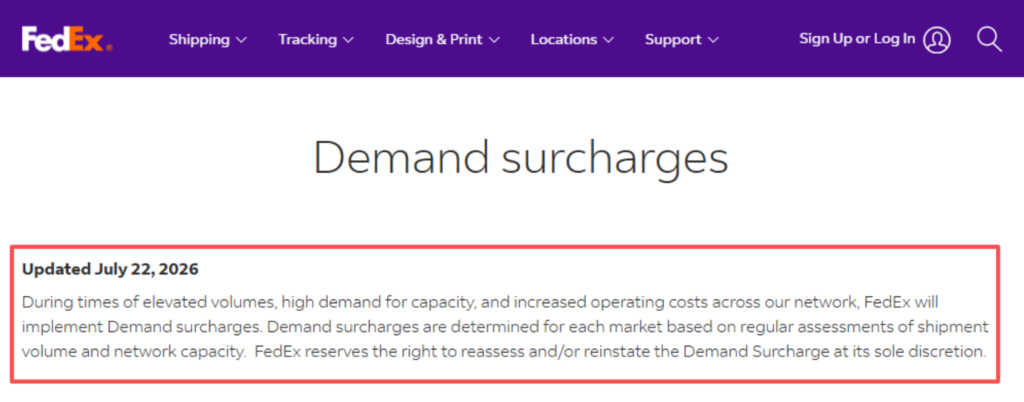
As the peak season preparations for 2026 kick off in the second half of the year, global courier giant FedEx has officially announced its 2026 peak season surcharge adjustment plan!
This price adjustment not only covers a longer period and has a higher rate, but also adopts a new model of phased implementation and tiered charging for the first time, marking a systematic restructuring of the cost structure of cross-border e-commerce logistics.
For cross-border sellers targeting the US market, the second half of the year is the time when profits are truly tested: not only are there the peak sales seasons of Black Friday and Christmas, but also the continuously rising logistics costs during these periods. The growth in orders may not always bring profits; it may also be accompanied by a rapid increase in delivery costs.。

Unlike the previous practice of uniformly raising prices at the same time, the FedEx peak season surcharge for 2026 adopts a phased initiation and stepwise increase collection method.
The entire charging policy covers the period from the end of September 2026 to January 17, 2027, fully spanning the Black Friday, Cyber Monday, Christmas, New Year and other core sales periods throughout the year.
FedEx implements this stepped price increase model mainly to regulate the overall package transportation capacity across the network through floating price adjustments and balance the transportation resources during the peak season. However, for cross-border sellers, all the regulatory costs will ultimately be passed on to the shipping end.
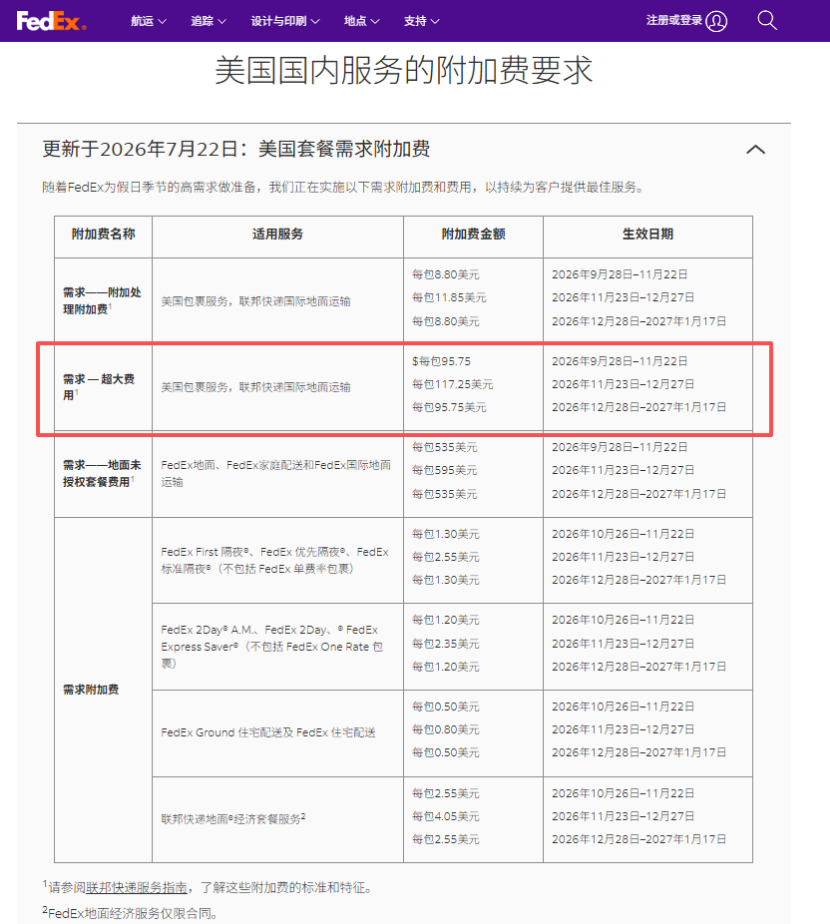
According to the information released by FedEx, the peak season surcharge mainly covers various aspects such as residential delivery, economical delivery, oversized items, and special handling services. The overall charging level has increased compared to the same period in 2025.
▼ Residential Delivery Surcharge (Effective from October 26, 2026 to January 17, 2027):
1、Volume-based charging (based on shipment volume):
For most courier services (including Ground, Home Delivery, Express, etc., except FedEx One Rate), the residential delivery surcharge per item ranges from $1.70 to $9.35.
2、Fixed/Basic Residential Surcharge:
FedEx Ground Residential Delivery: Each item charges $0.50 to $0.80.
FedEx Ground Economy (Economical Ground Service): Each item charges $2.55 to $4.05.
Many sellers usually choose the relatively cheaper economical ground delivery service. However, this year, FedEx has imposed the heaviest surcharge on this channel for residential delivery.
The original profit margin of the economical service is already thin. Now, each order incurs an additional cost of $2.55 to $4.05, which is likely to directly eat up the entire profit of low-price, low-volume product sellers.
▼ Various Large Items and Special Handling Surcharges: (Large items/Overweight/Non-standard items, effective from September 28, 2026 to January 17, 2027)
Additional Handling Surcharge: Each item charges $8.80 to $11.85.
Oversize Charge: Each item charges $95.75 to $117.25.
Ground Unauthorized Package Charge: Each item charges $535 to $595.
Important rule: Penalties are linked to volume growth! The billing base is the customer's average volume from June 1st to 28th. The higher the volume growth during the peak season, the heavier the additional penalty faced.
Key affected groups: Enterprise-level e-commerce sellers with an average monthly residential shipment in the US and Ground Economy shipments exceeding 20,000 items.
In addition to the above-mentioned peak season surcharges, sellers also need to be aware of the additional costs resulting from the adjustment of postal code zones and the adjustment of base freight rates.
▼ Reclassification of US Postal Code Areas: On July 20th, FedEx officially updated the classification of postal code charges for door-to-door pickup. A large number of areas were reclassified into higher charge levels, and new postal codes were included in the scope of surcharge collection:
102 new postal codes for remote addresses
74 new postal codes for extended remote addresses
63 new postal codes for extremely remote addresses
In terms of differences: Commercial items were upgraded from extended remote to extremely remote, and the single-piece delivery surcharge increased by $11.2; residential items were accordingly increased by $7.95. The pickup surcharge was also adjusted. For sites upgraded to extremely remote areas, a one-time pickup surcharge of $7.2 was added.
For sellers, this means that the logistics costs for shipping to certain areas may increase unconsciously. If orders are concentrated in these postal code areas, it is necessary to re-calculate whether the single-piece profit can still cover the additional costs.
▼ Synchronous increase in base freight rates:
Furthermore, FedEx previously announced that starting from January 5, 2026, the average standard pricing for US parcel transportation services will increase by 5.9%, and the increase for some services can reach up to 6.9%.
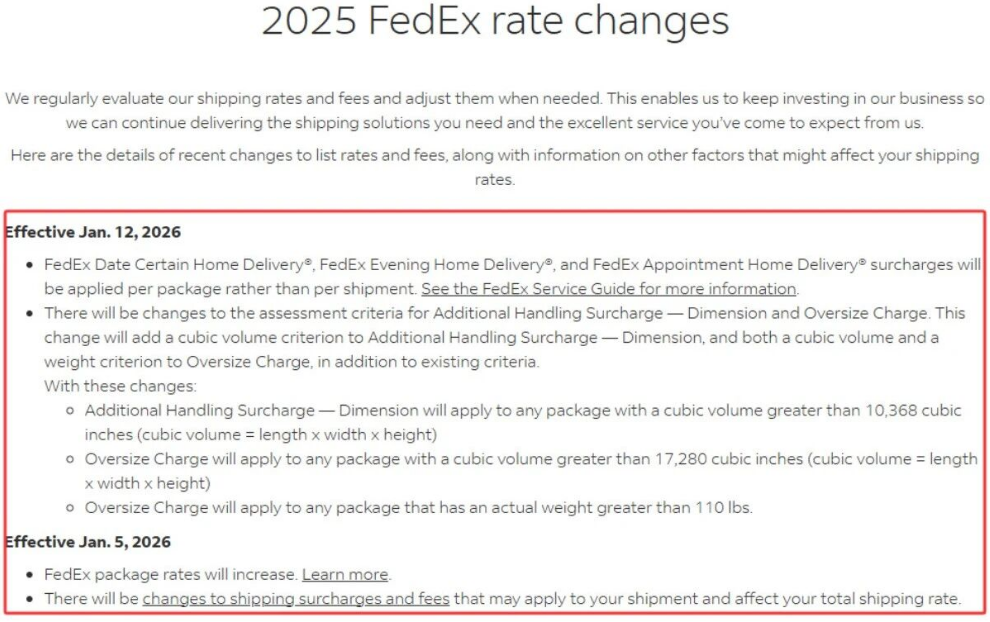
The double increase in base freight rates and peak season surcharges will further squeeze the profit margins of sellers!
For ordinary small-item sellers, an increase of a few cents per shipment may have limited impact. However, if there are hundreds or even thousands of shipments per day, the cumulative cost can be considerable.
For sellers of furniture, outdoor products, fitness equipment, large household items, etc., they need to pay special attention to the extra size charges: Many sellers usually only focus on the base freight rate but tend to overlook the residential fees, remote fees, oversized fees and other additional items during the peak season. As a result, the actual profit is lower than expected.

In response to the multiple hikes in FedEx freight and surcharges, an increasing number of medium and large-sized sellers are shifting their focus to the overseas warehouse one-stop shipping model.
Pre-positioning goods in overseas warehouses and replacing cross-border direct shipping with local last-mile delivery is the core strategy to avoid the impact of peak season surcharges and maintain the profit bottom line.
As an overseas warehouse service provider specializing in the medium and large-sized goods market in the United States, Anme relies on 12 years of local operation experience, self-developed intelligent systems and standardized warehousing fulfillment system to provide integrated logistics services for cross-border sellers, including nationwide US warehousing, one-stop shipping, last-mile delivery, and return and label exchange.

The Ammei group overseas warehouse network is located in key logistics hubs in the United States such as Los Angeles, New Jersey, Atlanta, Savannah, and Houston. It has 11 fully self-owned overseas warehouses, with a total storage area exceeding 2.45 million square feet. The warehouse network fully covers the three core regions of the western, eastern, and southern parts of the United States.
Combined with the self-developed WMS intelligent warehousing system and intelligent reservation system, it can achieve intelligent warehouse division, pre-shipment preparation, and nearest delivery based on the destination of the order, the logistics heat of each region in the United States, and the inventory distribution. This significantly reduces cross-region delivery costs and timeframes. The delivery coverage in the United States is only 1-5 days, and in some areas, next-day delivery can be achieved.
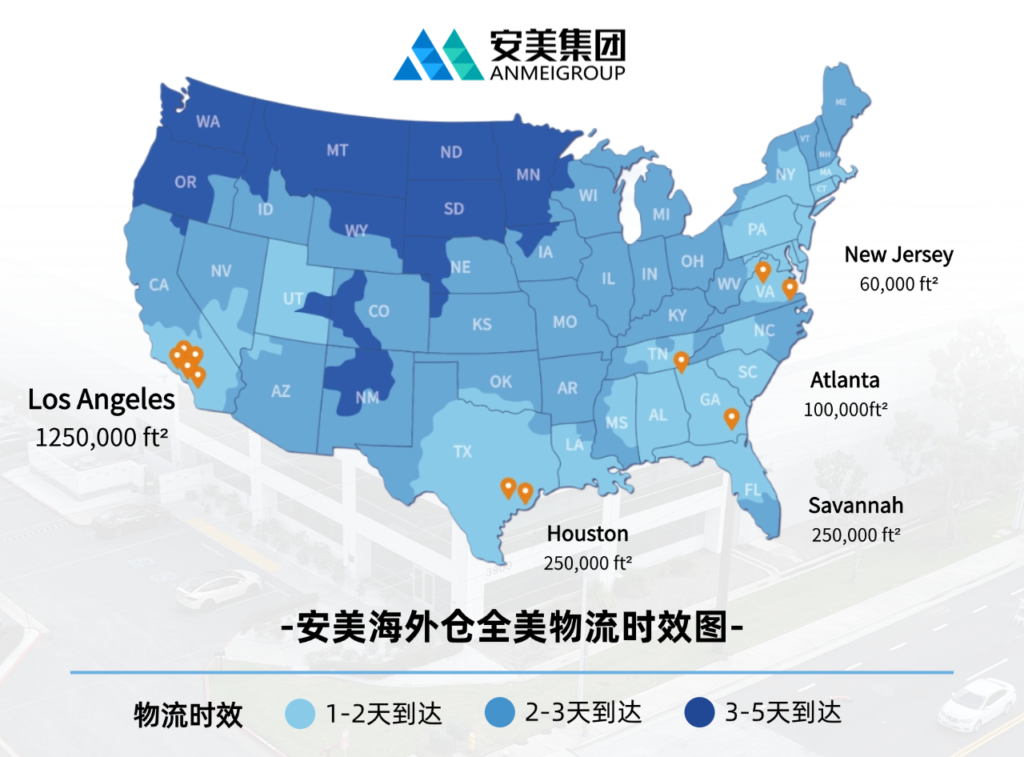
Anme Group and FedEx are closely-knit strategic partners, with both sides having years of successful cooperation experience and consistent market accumulation. Based on their deep partnership and large volume of shipments, Anme can secure highly competitive peak season surcharge discounts for its cooperative customers!
During the peak season, Anme can offer customers a tail-end discount as low as 20% off the official price, especially in terms of the freight charges for large and overweight goods, which is particularly advantageous.
Customers do not need to negotiate with the courier companies themselves; they can simply select the most favorable delivery channel with one click. The system can also automatically match the most cost-effective logistics channel based on the destination, weight, and size of the package, ensuring intelligent and efficient delivery.

💡This means that when there is a $0.80 per unit residential delivery surcharge in the market, Ami customers only need to pay a fee much lower than the market level; when competitors are overwhelmed by the $117.25 per unit oversized surcharge, Ami customers can still keep their costs under control through Ami's discount account.
In addition, for medium and large-sized sellers, the discount advantage of OS (Oversize) oversized items is particularly crucial!
Ami has highly competitive discounts on OS oversized items' last-mile prices. The last-mile costs for medium and large-sized products are often several times or even dozens of times that of smaller items. An account with a deep discount for OS oversized items could be the key step for turning a cross-border business from loss to profit this year.
Finally:
The increase in logistics costs during the peak season in 2026 is a certainty. For sellers preparing to rush the Black Friday and Christmas markets, what they need to do now is not only optimize advertising and inventory, but also re-calculate logistics costs.
The more peak-season orders there are, the more obvious the impact of logistics costs will be. Planning transportation schemes in advance, controlling possible additional costs within a predictable range, is the key to truly converting sales growth into profit growth.
✅ Ami Overseas Warehouse suggests sellers start from now:
Calculate Q4 logistics costs: Incorporate the peak-season surcharges into the single-item cost model and re-evaluate the profit margin
Formulate stocking plans: Grasp the golden window period from October 26th to November 22nd, and complete stocking in advance
Evaluate multi-warehouse layout: Optimize overseas warehouse locations and inventory distribution based on sales area distribution
Connect with logistics service providers: Confirm the peak-season channel plans, surcharge exemptions policies, and alternative plans in advance
After all, the peak season is not only a sales season, but also a "peak season" for logistics costs. Whoever figures out this equation first will have more initiative in the competition.
If you have an overseas warehouse requirement in the United States, you can scan the QR code to add the Ami Overseas Warehouse customer service WeChat. We will provide customized last-mile discount plans and stocking suggestions based on your actual situation.